
Procurement Negotiations
There is a specific moment in every software negotiation where the buyer loses, and it usually happens before anyone has mentioned a price.
It’s the moment the buyer decides this is a conversation about discount.
From that point the seller is on ground they know intimately. They have run this exact conversation with this exact product against buyers exactly like you, and they have a discount matrix, a deal desk, an approval ladder and a quarter-end clock. You have a spreadsheet and a stakeholder who has already decided.
The asymmetry is not about skill
Look at the workload on both sides.
A technology sourcing professional carries twelve to eighteen open projects at any moment and closes somewhere between forty and sixty deals a year across dozens of suppliers. Spread across that, a single renewal gets a few hours of genuine attention.
The account executive opposite sells one product line. They will run your category of deal a hundred and fifty to two hundred times this year. Their employer puts them through four to six weeks of paid training annually, and a meaningful share of that training is specifically about negotiating against procurement.
Their legal team negotiates one contract. Yours. Your legal partner reviews hundreds of different agreements in hundreds of different formats, of which software is one category among many.
That isn’t a skill gap. Procurement people are not worse negotiators than salespeople. It’s a preparation gap and an information gap, and both are closeable inside a single deal cycle.
What the gap actually costs
Here is a renewal that plays out constantly.
Current contract, £500,000 a year. The vendor proposes a nine percent increase, so £545,000. The buyer pushes back properly. They bring usage data, they reference the market, they are firm and professional. After three weeks the vendor comes down to three percent, £515,000.
Thirty thousand off the opening position. Most organisations write that up as a saving and move on.
Now model the full term rather than year one.
| Outcome | Year 1 | Three-year cost |
| Accept the 9% | £545,000 | £1,752,120 |
| Negotiate to 3% | £515,000 | £1,655,674 |
| Flat price, capped uplift, reduction rights | £500,000 | £1,388,632 |
The gap between the respectable outcome and the right one is £267,041.
The headline price moved by £15,000.
Nobody in that room spent three weeks on the increase clause, the right to hand back unused licences, or the mechanism that prices the next renewal. Those three things were worth seventeen times more than the number everybody argued about, and every one of them is easier to win, because the account executive isn’t compensated on any of them.
Price is one variable out of thirty-four
That’s the finding that reorganises how you buy software.
A software contract contains roughly thirty-four genuinely negotiable variables. The annual uplift cap and what it compounds against. The contractual definition of a user. True-up triggers and true-down rights. Overage pricing. Non-production environments. Data egress and export completeness. Audit scope, notice and rate. Renewal pricing mechanism. Affiliate and acquisition rights. Deprecation and tier migration protection.
Price is one of them, and on worked examples it is not the most valuable one. An uplift cap beats a ten percent discount. Reduction rights beat both. The definition of a user beats all three on a growing headcount.
Buyers spend eighty percent of their effort on the single variable the seller was best prepared to concede.
What to do about it
Three things, in this order, and none of them require a bigger budget or a better negotiator.
Start earlier. Nearly every advantage available to a buyer depends on time, and time is the only variable you control completely. A hundred and eighty days gives you a usage audit, a completed alternative, a briefed stakeholder group and the ability to reach the vendor’s year end without your own deadline pressing. Thirty days gives you none of that.
Learn how the other side gets paid. The account executive’s compensation, their deal desk’s approval thresholds and their finance team’s revenue recognition rules determine which of your asks are free and which are structurally impossible. Once you can see those three things, their behaviour becomes predictable.
Negotiate the terms before the price. Not as a tactic, but because the rep is measured on annual contract value and nobody in a sales compensation plan is measured on whether your contract contained an auto-renewal clause.
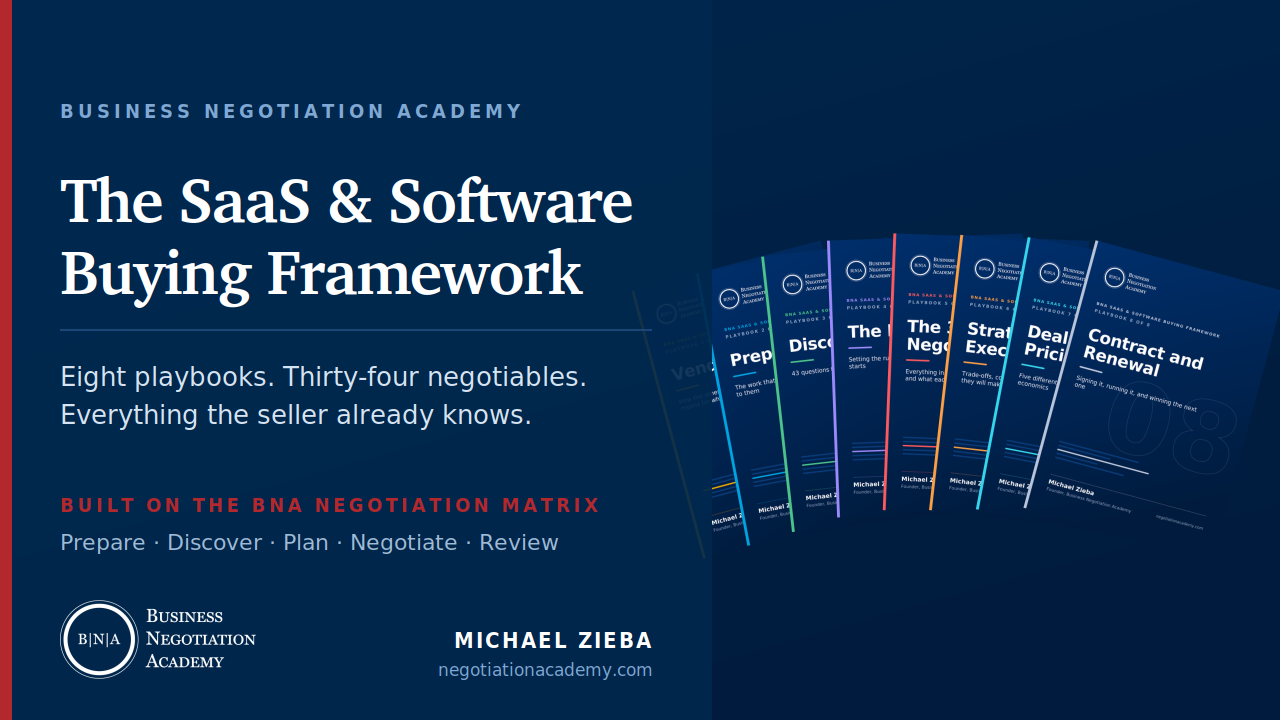
Over the next eight days I’m publishing one article on each part of the framework: vendor economics, preparation, discovery, the RFP, the thirty-four negotiables, strategy and execution, deal types and pricing models, and contract and renewal.
Start with the one closest to the deal on your desk.
Share
Recent Posts

August 31, 2026
The Price Negotiation Playbook: You’re Negotiating Against People Who Practise. With Instinct.
Your buyers negotiate for a living, or they’ve been trained by every seller who folded before you. You improvise. That gap has a...
August 26, 2026
The SaaS / Software Procurement Playbook: The Four-Line Clause That Cancels Everything You Negotiated
Imagine you’ve done everything right. Six weeks of negotiation. You won the uplift cap, the reduction rights, the data export terms, a limited...
August 25, 2026
The SaaS / Software Procurement Playbook: You Won £15,000. You Left £267,041.
Applying renewal tactics to a new purchase, or new-purchase optimism to an audit, is how buyers lose money while working hard. There are...