
Salary Negotiation
Most people think a salary negotiation is a conversation. It isn’t. It’s a series of moves, and the person across the table has rehearsed theirs for a living.
I know, because I trained them.
For two decades I’ve taught procurement teams at Fortune 500 companies (Ecolab, Vodafone, Pfizer, Mars, DHL) how to sit across from a supplier and extract every pound of value from the deal. The flinch when they hear the first number. The silence that makes you fill the gap. The trade where nothing is ever given for free. These aren’t tricks. They’re a discipline, and the buyers I train are very, very good at it.
Then I watched the same people, brilliant at negotiating millions on behalf of their employer, walk into their own salary review and take the first number they were offered.
That gap is what this article is about, and it’s costing you more than you think.
Why the money conversation is the one you’re least ready for
You’ll spend weeks preparing for an interview. You research the company, rehearse your answers, plan what to wear. Then you reach the part that actually sets your pay for the next several years, and you improvise.
The person on the other side does not improvise. Recruiters and hiring managers run this conversation dozens of times a year. They know their band, their deadline, and roughly what you’ll accept. You run it three or four times in your entire career.
That asymmetry, their fluency against your rare exposure, is the real disadvantage. Not your confidence. Not your worth. Your reps.
And here’s the part that stings: a small gap compounds. A £4,000 shortfall on your starting base isn’t £4,000. Every raise you ever get is a percentage of that base. Every future offer is benchmarked against it. Over a career, one under-negotiated number quietly becomes tens of thousands you never see, and you never find out it happened. You just work for a figure you could have moved, and feel the quiet resentment of it every payday.
The negotiation is won before you’re in the room
Here’s the single most important thing I can tell you, and it’s the thing almost no salary advice covers.
You don’t lose the negotiation in the meeting. You lose it in the weeks before, when you arrive with no alternative, no read on the employer, and no ability to walk away.
Leverage is not something you’re born with or stuck with. It’s built, deliberately, before the conversation starts. The candidate with a second offer, a clear picture of the employer’s urgency, and a real walk-away negotiates from a completely different place than the one with none, even when they use the exact same words.
So before you think about scripts, do the work that gives the scripts something to stand on.
Run more than one process at once. A single offer makes you a supplicant. A second one, even a weaker one, changes everything, because now the employer has to win you rather than simply approve you.
Strengthen your walk-away. The number you’ll accept is set by your best alternative, not your hope. A month of savings, a current job you could stay in, a fallback you’d genuinely take, each one changes how you negotiate.
Learn about them before you talk numbers. How long has the role been open? When does their financial year end? Who actually signs off on the offer? A candidate who knows the role has been open five months and closes at quarter-end holds cards the employer doesn’t realise they’ve shown.
None of this happens in the room. All of it decides what happens there.
Never name a number first
When the salary question comes early, and it always comes early, most people answer it. That’s the mistake. The moment you name a figure before there’s an offer, it becomes your ceiling. You can rarely go up from it, and they’ll almost always try to pull you down.
The skill is deflecting, gracefully, until there’s a real offer on the table.
When they ask what you’re expecting, turn it around: “To make sure we’re aligned, what range does this role sit in?” You’re not being evasive. You’re asking them to go first, which is fair and normal, and it keeps their range, not your guess, as the thing that gets revealed first.
Hold that line even when they push. The discomfort of not answering is the price of your leverage. Sit in it.
The moves that change the number
Once an offer exists, the game shifts from deflection to tactics. These are the same plays professional buyers use, and they work just as well on your own pay. A few of them:
The flinch. React, visibly, to their first number before you speak. A pause, a slight wince, the number repeated back. People rarely expect a reaction, and the reaction alone often produces movement before you’ve made a single argument.
The silent anchor. State your number, then say absolutely nothing. Silence after an anchor is one of the most powerful and underused moves there is. Most people cannot tolerate the pause, so they fill it, often by negotiating against themselves. Your only job is to not speak first.
The trade-off. Never give anything for free. Every time you concede something, get something back. Not because you always need it, but because a free concession trains them to expect more, while a traded one trains them to stop pushing. “I can be flexible on the start date if you can be flexible on the sign-on.”
Open questions, not closed ones. “Is there flexibility?” invites a no. “What flexibility is there?” makes them describe the room they have. One word, a completely different answer.
Notice what none of these require: aggression, ultimatums, or talking more. The best negotiators aren’t louder. They’re calmer, because they prepared.
Handle the pushback, don’t fold to it
Every employer has a small set of standard objections, and they’re so predictable you can prepare for each one.
“That’s the top of our budget.” Rarely literally true. Bands flex for the right person, and where they don’t, other levers do: sign-on, an earlier review, title.
“We can revisit at your review.” A soft no dressed as a yes. A review raise starts from a lower base, so the gap compounds. Ask for the number and the date in writing now.
“The offer’s already generous.” An emotional reframe designed to make you feel greedy. Your gratitude for the opportunity and the market value of the role are two different things. You can be thrilled and still ask to be paid correctly.
The thing to understand: almost every objection is a comma, not a full stop. An opening position, a reflex, a test. The negotiators who win are simply the ones who don’t stop at the first no.
It’s not just the base
Most people negotiate one number and leave everything else untouched. That’s a mistake, because base is often the least flexible part of the package and the rest is where the room is.
Sign-on bonuses, equity and how fast it vests, an earlier review, extra leave, title, remote arrangement, relocation support, the whole thing is negotiable, and much of it is easier to grant than base because it doesn’t break a pay band or set a permanent precedent. When base is capped, you don’t walk away. You say: if base is fixed, let’s make the rest work harder.
What to do with this
Everything above is real, and you can use it on your next conversation. But it’s a fraction of what actually goes into a negotiation you walk away from having won.
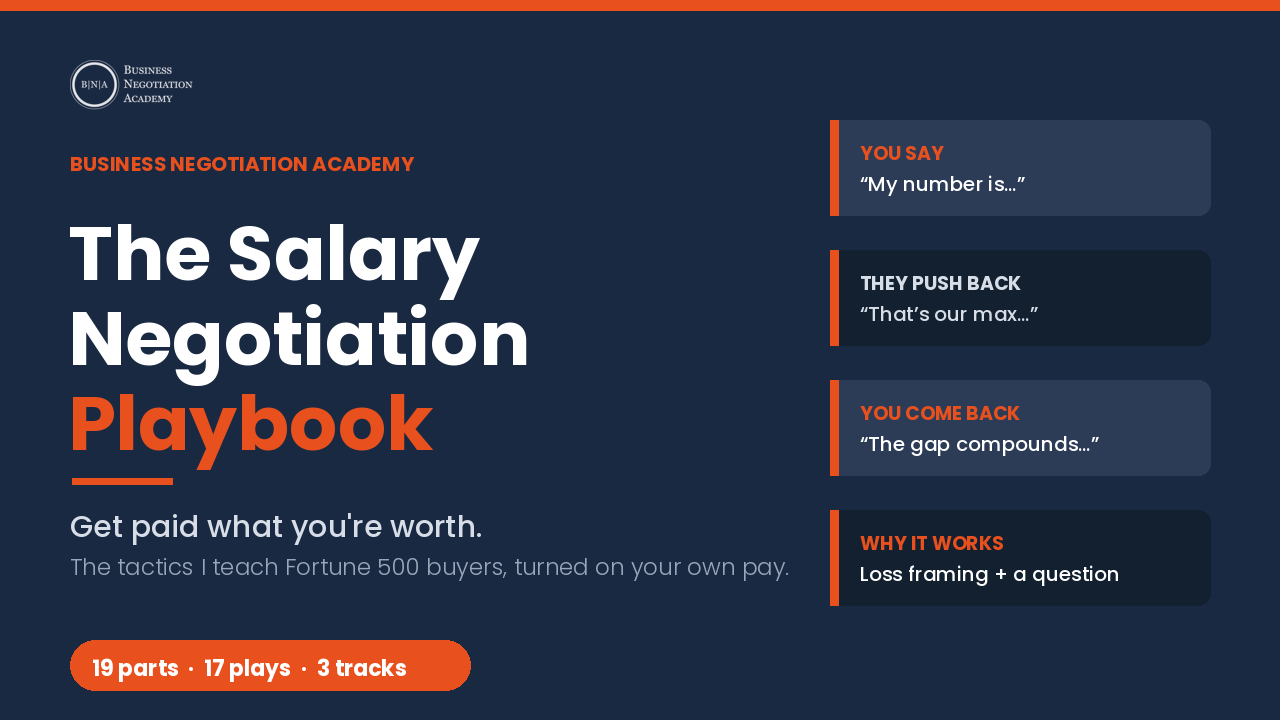
I put the complete system into a playbook: how to build leverage before you ask, how to know your number, the full set of 17 tactical plays with the exact words and how to counter them when they’re used on you, every employer objection answered, the whole conversation planned end to end, and three tracks for your specific situation (a new offer, a raise, or senior comp with equity and bonus).
It’s written from the buyer’s side, by someone who spent two decades training the people you’re negotiating against. That’s the difference. Every other guide is written from the candidate’s side, guessing at what employers think. This one isn’t guessing.
Your next salary conversation is coming, whether you’re ready or not. You can walk in with a number and a hope, or you can walk in as the most prepared person in the room.
[Get the Salary Negotiation Playbook →]
The Salary Negotiation Playbook
Share
Recent Posts

August 31, 2026
The Price Negotiation Playbook: You’re Negotiating Against People Who Practise. With Instinct.
Your buyers negotiate for a living, or they’ve been trained by every seller who folded before you. You improvise. That gap has a...
August 26, 2026
The SaaS / Software Procurement Playbook: The Four-Line Clause That Cancels Everything You Negotiated
Imagine you’ve done everything right. Six weeks of negotiation. You won the uplift cap, the reduction rights, the data export terms, a limited...
August 25, 2026
The SaaS / Software Procurement Playbook: You Won £15,000. You Left £267,041.
Applying renewal tactics to a new purchase, or new-purchase optimism to an audit, is how buyers lose money while working hard. There are...